



What Is Double Mesh Fencing? And When Your Club Needs It

"Double mesh" is the specification clubs hear about most in connection with FA ground grading, but the term is rarely explained clearly. This guide sets out exactly what double mesh fencing is, how it differs from single mesh and post-and-rail, what the FA actually requires at the higher steps, and how to decide whether your club needs it now or later. If you want the requirement by step first, start with what fencing your club actually needs.
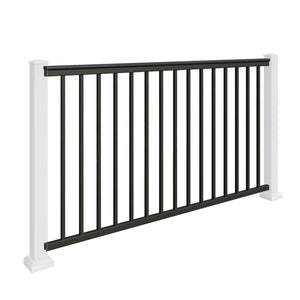
Double mesh fencing has welded mesh infill panels in both the upper and lower sections of every bay — between the top and middle rail, and between the middle and bottom rail. That creates a continuous barrier the ball cannot pass through or roll under, which is exactly what the FA's infill requirement at Steps 1–4 calls for. Single mesh has infill in one section only; post-and-rail has none.
The Three Infill Levels Explained
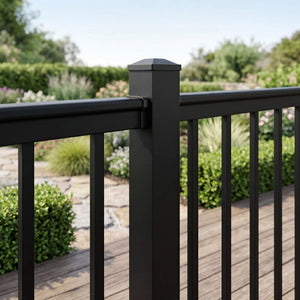
All three systems share the same posts and rails — 127 × 127mm PVCu posts at 2,500mm centres, three rails per bay, 1.1m to the top rail. The only difference is the infill between the rails.
| System | Infill | Ball containment | Typical use |
|---|---|---|---|
| Double Mesh | Upper + lower panels | Full | FA Steps 1–4 |
| Single Mesh | One section | Partial | Steps 5–7 |
| Post & Rail | None | Demarcation only | Step 7 / training |

How the Panels Are Built
The infill is double-layer welded steel mesh, white powder-coated to match the posts and rails, with a hole size of 155 × 75mm. The panels slot into pre-drilled holes in the rails and clip into position without additional fixings or specialist tools, which is what makes the system realistic for a club work party to install.
Because the mesh is steel rather than plastic, it holds its shape against a ball struck hard from close range — but it sits behind PVCu rails, so what a player actually makes contact with is the flexible part. That combination is the point of the design: containment from the steel, impact absorption from the PVCu.
What the FA Actually Requires at Steps 1–4
This is worth stating precisely, because it is widely misquoted. The FA's Stadium Accreditation Criteria require a permanent infilled barrier at Steps 1–4 that prevents the ball passing through or under it. The criteria do not name double mesh, and they do not name any manufacturer or product.
What they describe, though, is a barrier with no gap between the rails and no gap beneath the bottom rail. A single rail, or a barrier with a gap under the lowest rail, does not achieve that — a ball can pass between rails or roll underneath onto a spectator area or out of play.
Double mesh closes both gaps by design, which is why double mesh is the standard specification at the majority of Step 1–4 grounds. It satisfies the requirement rather than being the requirement — a distinction worth holding on to when a supplier tells you the FA insists on their product. Our ground grading reference sets out the criteria as written.
The FA explicitly excludes hi-vis orange or yellow plastic multi-purpose fencing as infill at the graded steps. If your ground currently uses it, it will need replacing before inspection — this is one of the most common grading failures, and it is covered alongside the others in 5 reasons clubs fail ground grading.
From 2026/27 the FA prohibits solid brick, breeze block and concrete pitch perimeter barriers across Steps 1–6 and Women's Tiers 3–4. If you are replacing a wall rather than upgrading a fence, double mesh is the usual answer — and the Premier League Stadium Fund will contribute up to 100% of the cost of removing or protecting the wall, against a standard 70% for a new barrier.
Should Your Club Install Double Mesh Now?
The case for fitting double mesh even below Step 4 comes down to one word: promotion. If your club has any ambition to climb, installing double mesh now means never having to replace a compliant fence later.
Steps 1–4, or aiming for them
Install double mesh
An infilled barrier is required at these steps and double mesh is the standard way to meet it. It is also the safe choice for any club with promotion ambitions — the marginal extra cost over single mesh is £7 per metre installed, which is far less than replacing a fence on promotion.
Double meshSettled at Steps 5–6
Single mesh may suffice
A single mesh barrier meets the permanent-barrier requirement, with infill in one section. Weigh it against your promotion plans rather than against this season.
Single mesh optionStep 7 / training pitches
Post & rail
Post & rail provides demarcation where full ball containment is not required. Bear in mind there is no national grant route for a barrier at Step 7 and below.
Post & rail optionOn a standard pitch the difference between double and single mesh, supplied and installed, works out at roughly £2,450 across the full perimeter. Our 2026 price guide breaks down all three systems with worked totals.
Specify the Right Mesh for Your Step
From double mesh for graded grounds to post & rail for training pitches, the Norvale Sport system matches the requirement for your level. Supply only or fully installed, nationwide — free quote within 24 hours with grant-ready specifications.
Get a Free Quote View Double MeshNorvale Sport is a trading name of The Outdoor Look Limited, registered in England and Wales No. 11676614. VAT No. 232 7154 28.