




Single Mesh Pitch Fencing — Norvale Sport PVCu System
The Permanent Barrier for Steps 5 to 7
A single welded mesh panel in the lower section, closing the gap a ball actually rolls through. Meets the permanent barrier requirement at FA Steps 5–7 and across community rugby, at £5 per metre less than double mesh. Independently tested, zero maintenance, 15-year warranty.
✓ Meets Steps 5–7 requirement ✓ High ball retention ✓ Independently tested ✓ 15-Year Warranty ✓ Zero Maintenance ✓ PLSF fundable
Be clear about what single mesh does and does not do
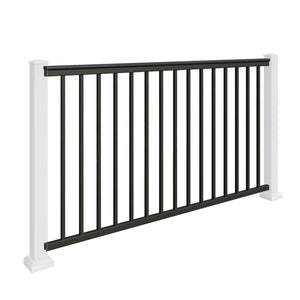
Single mesh carries one welded panel, fitted between the bottom and middle rails. That closes the lower gap, which is where a ball rolls out and where a spectator is most likely to step through. The gap between the middle and top rails stays open. That is why single mesh does not satisfy the infilled barrier requirement at FA Steps 1–4, which asks for a barrier a ball cannot pass through at any point. If your club is at Step 4 or above, or expects to be, you need double mesh. At Steps 5–7 and across community rugby, single mesh is a permanent infilled barrier and meets the requirement.

A single mesh bay — one welded panel in the lower section, open between the middle and top rails.

Pricing
Per linear metre of completed fence, ex VAT. Includes posts, rails, mesh panels and fixings. Gates and delivery are itemised separately on every quote and never folded into the metre rate.
Supply only
£54/m
Delivered to your ground
Installation
£30/m
Our managed teams
Supply & install
£84/m
Fully installed, ready for inspection
Single gate (1.5m) £500 · double gate (3.0m) £1,000 · delivery £500 flat with Moffett off-load. Across a standard pitch, choosing single mesh over double saves roughly £2,470 installed. For a worked total, see our 2026 price guide.
System Specification
SystemNorvale Single Mesh — 3-rail PVCu post and rail with single-layer welded mesh infill
Mesh infillOne welded steel mesh panel per bay, white powder-coated, 155 × 75mm hole size — fitted between the bottom and middle rails, supplied separately and slotting into pre-drilled holes in the rails
Post127 × 127mm PVCu section, 1,800mm supplied length
RailPVCu extrusion, 2,449.2mm overall with a 38.1mm tenon at each end · 3 rails per bay · sliding mortise connection
Bay centres2,500mm
Barrier height1.1m to the top of the top rail, measured from the spectator side. The post stands 1,200mm above ground to the post top
Post hole300mm diameter × 750mm deep
Post embedment600mm · 150mm concrete base beneath the post, concrete surround to 150mm below ground level, 150mm soil backfill at the surface
Concrete per postApproximately 85kg — four to five 20kg bags
Thermal expansion gap10–12mm between rail sections at each post
ColourBright white PVCu · does not fade, yellow or discolour
Gate hardwareGrade 304 stainless steel throughout — hinges, latches, drop bolts
Gate modulesSingle 2,024mm overall (1,643mm clear) · Double 3,637mm overall (3,256mm clear)
TestingIndependently tested and audited — UV resistance, high temperature, low temperature, factory quality audit. UV weathering to ASTM G154 returned a colour change of ΔE 0.70 after 1,000 hours
Warranty15 years product warranty
Recommended setback2,250mm from the edge of the playing surface for football. Rugby run-offs are larger — see the rugby union and rugby league pages
Service optionsSupply only, UK-wide · Supply & install across the North of England and expanding
Full setting-out detail, including the foundation sequence and concrete quantities, is on our installation guide.
Suitable For
Football — FA Steps 5–6
Meets the permanent infilled barrier requirement at these steps.
Football — FA Step 7
Comfortably above the minimum, with real ball retention.
Community Rugby
Suits regional and community grounds in both codes.
Schools & Academies
The usual choice for school pitches, which are not subject to FA grading.
Leisure Centres
Multi-sport pitches and MUGAs where ball retention matters more than grading.
Not for FA Steps 1–4
Those steps require infill top and bottom. Specify double mesh.
How It Compares to the Rest of the Range
| Feature | Double Mesh | Single Mesh This system |
Post & Rail |
|---|---|---|---|
| Meets FA Steps 1–4 infill requirement | ✓ | – | – |
| Permanent infilled barrier | ✓ | ✓ | – |
| Meets FA Steps 5–6 permanent barrier requirement | ✓ | ✓ | – |
| Meets FA Step 7 minimum | ✓ | ✓ | ✓ |
| Ball retention | Maximum | High | None — demarcation only |
| Spectator separation | ✓ | ✓ | Minimal |
| Accepted material for a PLSF-funded barrier | ✓ | ✓ | ✓ |
| 15-year warranty | ✓ | ✓ | ✓ |
| Independently tested | ✓ | ✓ | ✓ |
| Supply only, per metre ex VAT | £59 | £54 | £49 |
| Supply & install, per metre ex VAT | £91 | £84 | £77 |
Frequently Asked Questions
Is single mesh enough for our club?
It depends entirely on your step. At Steps 5–7 and across community rugby, yes — it is a permanent infilled barrier and meets the requirement. At Steps 1–4 it does not, because those criteria call for a barrier the ball cannot pass through at any point, and single mesh leaves the upper section open. If you are at Step 5 with a realistic chance of promotion, think carefully: specifying double mesh now costs about £2,470 more across a standard pitch, against replacing the whole barrier later.
What does single mesh cost for a full pitch?
A standard 105 × 68m pitch with the barrier at a 2,250mm setback gives a gross perimeter of 364m. Gate modules are deducted from that, not added — two 3.0m doubles and two 1.5m singles take out 11.3m, leaving 353m of fence. At £84 per metre supplied and installed that is £29,652, plus £2,000 for the double gates, £1,000 for the singles and £500 delivery: £33,152 ex VAT.
Can we upgrade to double mesh later?
The frame is identical, so in principle you are only adding upper panels. The practical constraint is that the rails must be drilled for them. If there is any chance you will want to upgrade, tell us at order stage and we will supply rails drilled for both positions at no extra cost — it makes a later upgrade a straightforward panel order rather than a rail replacement.
Can we get funding for this fencing?
For clubs at Steps 1–6 of the National League System and Tiers 1–4 of the Women's Football Pyramid, the Premier League Stadium Fund contributes 70% of the cost of a new pitch perimeter barrier, rising to up to 100% where an existing solid brick, breeze block or concrete barrier must be removed or protected. The Fund holds no preferred supplier list. The Football Foundation does not fund pitch perimeter barriers, and at Step 7 and below there is no national grant route. We provide every specification document your application needs, free of charge. Read the full funding guide.
Why not just fit post and rail?
Post and rail is a boundary marker, not a barrier. It defines the edge of the playing area and keeps spectators back, but it retains no balls and does not meet the permanent infilled barrier requirement at Steps 5–6. At £5 per metre more, single mesh is the point at which the fence starts doing a job beyond demarcation. If your problem is balls leaving the ground, that £5 pays for itself quickly. See post & rail for where it does fit.
How long does installation take?
For a standard 11-a-side pitch of roughly 353m perimeter, a competent team of four with a mechanical post-hole borer typically completes installation over three days — posts on day one, concrete curing on day two, rails and mesh on day three. Allow a minimum of 24 hours curing before loading the posts. Read the full installation method.
Get a Quote for Single Mesh Fencing
Tell us your perimeter length, sport and service preference. We respond within 24 hours with a full quote and specification document — everything a Premier League Stadium Fund or RFU application needs.
Get a Free Quote Football Pricing & Steps
Double Mesh Fencing Post & Rail Fencing Football Pitch Fencing Schools & Academies FA Ground Grading Guide Get a Free Quote
Norvale Sport is a trading name of The Outdoor Look Limited, registered in England and Wales No. 11676614. VAT No. 232 7154 28.
- Choosing a selection results in a full page refresh.