




RFU Ground Requirements Explained: Fencing for Rugby Union Clubs

Rugby union grounds are governed by a different rulebook to football, and the perimeter requirements reflect the different shape of the game — bigger playing enclosures, much wider run-offs and a strong emphasis on player safety beyond the touchline. This guide explains what World Rugby's Law 1 requires of the playing enclosure and perimeter, where a barrier can and cannot sit, and how the funding routes differ from football. If you are comparing materials, start with PVC vs steel vs timber.
Under World Rugby's Law 1, the perimeter area around the field of play should be five metres wide where practicable, and no less than 3.5m for the men's game or 3.0m for the women's game. The field plus perimeter together form the "playing enclosure". Any fixed barrier sits beyond the perimeter area, never within it — which means a rugby fence line sits considerably further from the touchline than a football one.
The Playing Enclosure and Perimeter Area
Law 1 (The Ground) defines the field of play, the in-goal areas and the perimeter around them. The field of play does not exceed 100m between try lines or 70m in width, with in-goal areas adding between 6m and 22m at each end. Around all of that sits the perimeter area, and the whole thing together is the playing enclosure.
The figure that governs your fence line is the perimeter width. Law 1 states it should, where practicable, be five metres wide, but no less than 3.5m for the men's game and 3.0m for the women's game.
| Measurement | Law 1 |
|---|---|
| Field of play, length | Up to 100m between try lines |
| Field of play, width | Up to 70m |
| In-goal depth | 6m to 22m at each end |
| Perimeter area, recommended | 5m where practicable |
| Perimeter area, minimum — men's | 3.5m |
| Perimeter area, minimum — women's | 3.0m |
Two points that are easy to miss. World Rugby is explicit that reducing the perimeter below five metres should only be done following a full risk assessment. And it recommends the run-off surface matches the field of play for at least the first 2.5m from the touchline — so a barrier set at the bare minimum on a hard or uneven surface is not really meeting the intent, even if the tape says it complies. Our RFU ground requirements page covers the detail.
This is the single biggest difference, and it catches out clubs that have read football guidance. Where a football barrier sits 1.83m to 2.25m from the line, a rugby barrier sits beyond a perimeter area of 3.0m to 5.0m. On a full-size pitch with 22m in-goals, that difference adds around 104 metres to the fence run — so do not budget a rugby ground off a football figure. Our measuring guide shows how to work out your own run, including the in-goal areas at the ends.

Why Player Safety Drives the Barrier Choice
Rugby is a collision sport, and players cross the touchline at speed during tackles and chases with no realistic prospect of stopping. Law 1 requires the surface of the playing enclosure to be safe, and World Rugby's stated reason for the five-metre recommendation is to minimise the risk of injury to a player leaving the field of play. The logic extends naturally to whatever the player meets at the end of that run-off.
A rigid steel or concrete barrier close to play is a serious hazard. Football has just acted on exactly this point — the FA's 2026/27 criteria prohibit solid brick, breeze block and concrete pitch perimeter barriers across its National League System, following the death of a young player who collided with a concrete wall. That prohibition does not apply to rugby, but the physics do, and it is a reasonable benchmark for any club assessing its own ground.
- It flexes on impact rather than presenting a hard, unforgiving edge.
- No sharp protrusions — smooth profiles with no exposed fixings at body height.
- Clear sightlines for spectators and officials without an industrial look.
- Maintenance-free in the wet, muddy conditions typical of a rugby season — no rust, no rot, no repainting.
Spectator Separation as Clubs Climb
As clubs move up the RFU league structure, the expectation of a defined, permanent barrier separating spectators from the playing enclosure increases, much as it does in football. For clubs hosting larger crowds, a continuous infilled barrier provides clear demarcation, helps with crowd management and presents a tidier ground. A single mesh or double mesh system suits most rugby grounds, and our guide to what double mesh actually is explains the difference.
Funding: Different Routes to Football
This is worth being clear about, because rugby clubs sometimes arrive at football funding pages and assume the same routes apply.
The 70% contribution towards pitch perimeter barriers that applies to FA National League System clubs is not open to rugby union clubs. Neither is the Football Foundation. For rugby union the starting points are the RFU's grant schemes and Grant Finder, Sport England, and the National Lottery community funding programmes, alongside local authority routes. Your RFU Facilities team or Constituent Body is the right first call, since they will know which schemes are currently open and how competitive they are.
Whichever route applies, the paperwork is broadly the same: a marked-up site plan, a full specification giving total metres, barrier height, construction and material, a gate schedule, an itemised quote and a schedule of works. We provide all of that free of charge within 24 hours of an enquiry. To be clear about our role, we supply the documentation your application needs — we do not secure funding and have no influence over the decision.
Specifying a Rugby Perimeter Barrier
Set the barrier beyond the perimeter area
5m where practicable, 3.5m / 3.0m minimum
Position the fence line at or beyond the Law 1 perimeter distance from every touchline and dead-ball line. Measure from the playing-area edge, and remember the in-goal areas extend the ends by 6m to 22m. If you cannot achieve five metres, carry out and record a risk assessment.
Respect the perimeterChoose a player-safe material
PVCu with flex
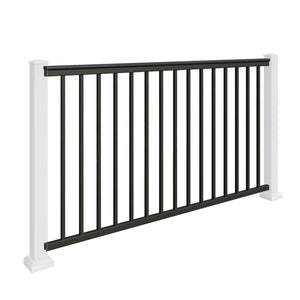
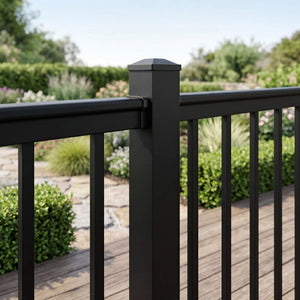
A 1.1m PVCu barrier with mesh infill gives clear separation while flexing on contact — the right balance for a collision sport. Independently tested for UV and temperature performance, with a 15-year warranty.
PVCu recommendedPlan gates for access
Pedestrian, machinery and emergency
Include single gates for player and official access and a double gate for groundcare machinery and emergency vehicles. Position them clear of the in-goal areas and away from the corners.
Access planningFencing Built for Rugby Grounds
The Norvale Sport PVCu system gives rugby union clubs a player-safe, maintenance-free perimeter barrier set correctly beyond the run-off. UK-wide supply, with installation across the North of England and expanding — free quote within 24 hours, with the specification documents a funding application needs.
Get a Free Quote Rugby Union FencingNorvale Sport is a trading name of The Outdoor Look Limited, registered in England and Wales No. 11676614. VAT No. 232 7154 28.