



Composite Balustrade: What It Is, How It Compares and What to Consider
If you are shopping for a decking balustrade and your deck is clad in composite boards, a composite balustrade might seem like the obvious match. Before you commit, it is worth understanding exactly what a composite balustrade is, where it falls short and how it stacks up against aluminium and glass alternatives. This guide covers the key differences so you can make the right choice for your project.
What Is a Composite Balustrade?
A composite balustrade is a railing system made from composite boards — typically a blend of recycled wood fibres and plastic (HDPE or PVC) — mounted on a hidden steel or aluminium frame. The boards are designed to colour-match composite decking ranges, giving the deck and its edge a uniform look. Most composite balustrade panels come in set lengths and heights, and they slot or screw onto the internal frame.
The composite material itself is the visible cladding. It is not the structure. The steel or aluminium skeleton inside is what carries the load and keeps the balustrade upright. This distinction matters when you start thinking about safety and regulations.
Pros of Composite Balustrades
- Colour matching: If your deck is finished in a particular composite range, the balustrade panels can match it exactly — same colour, same grain texture, same brand.
- Low maintenance: Composite does not need painting, staining or oiling. A wash with soapy water once or twice a year is usually enough to keep it clean.
- Consistent appearance: Unlike timber, composite does not warp, split or develop knots over time. The colour fades gradually and evenly rather than in patches.
Cons of Composite Balustrades
- Not self-supporting: Composite boards have no structural strength on their own. Every composite balustrade needs a steel or aluminium frame inside to carry the load. You are paying for two systems — the frame and the cladding — but only seeing one.
- Limited span: Because the panels come in fixed sizes, longer runs need more posts and more joints. This can look busy on a straight run and makes corners awkward.
- Heat sensitivity: Composite expands in warm weather and can soften or sag in direct sun. On south-facing decks, this can cause panels to bow between posts over time.
- Difficult to cut: Composite balustrade panels are not easy to trim to size on site. If your run is not an exact multiple of the panel length, you may end up with an awkward filler piece or a gap.
- Limited testing: Most composite balustrade brands do not publish independent load-test results to BS 6180. The structural performance depends on the hidden frame, and the frame specification varies between manufacturers. If your deck has a drop of 600mm or more, you will need to verify that the complete system — frame and cladding together — has been tested to the relevant barrier loads.
- Fewer fixing options: Composite systems are typically surface-mounted only, with limited options for side fixing or adapting to unusual layouts.
How Composite Compares to Aluminium Balustrade
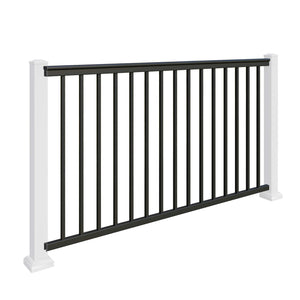
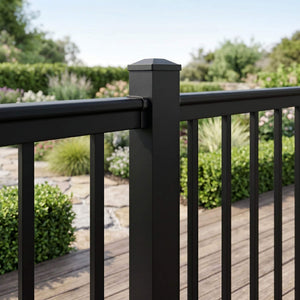
An aluminium balustrade is a self-supporting system. The posts, rails and infill panels are all structural aluminium — there is no hidden frame and no cladding over the top. What you see is what holds the load.
The key differences:
- Structure: Aluminium is structural in its own right. A composite balustrade relies on an internal frame that you cannot inspect once the panels are fitted.
- Testing: Our aluminium balustrade is load tested to the domestic (Category A) barrier loads in BS 6180:2011 and PD 6688-1-1. It is suitable for raised decks, steps and stairs with a drop of 600mm or more. Most composite systems do not offer this level of documented testing.
- Span and flexibility: Aluminium posts can be spaced further apart, which means fewer posts on a long run and a cleaner look. Aluminium also adapts to stairs, corners and changes in level more easily than fixed-size composite panels.
- Colour: Aluminium is powder-coated rather than colour-matched to a specific decking brand. It will not match your composite boards exactly, but it works with any decking colour and will not fade, peel or sag in the sun.
- Weight: Aluminium is significantly lighter than a composite-over-steel assembly, which makes it easier to handle and fix on site.
If your priority is a balustrade that stands on its own merits structurally and has documented load-test results, aluminium is the stronger choice.
How Composite Compares to Glass Balustrade
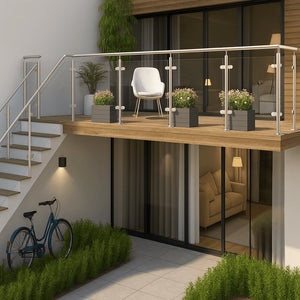
A glass balustrade takes a completely different approach. Instead of solid panels, you get toughened or laminated glass held in place by posts, channels or spigots. The result is an unobstructed view across your garden or landscape.
- Views: Glass is transparent. Composite is opaque. If your deck overlooks a garden, countryside or coast, glass keeps the view; composite blocks it entirely.
- System options: Glass balustrades come in several system types — semi-frameless, frameless channel, spigot and post and handrail — so you can choose the look and fixing method that suits your project. Composite is generally one style per brand.
- Guarding: Several glass balustrade systems are designed in line with BS 6180:2011 and are suitable for drops of 600mm and over. Composite systems need their hidden frame verified independently.
- Maintenance: Glass needs cleaning more often than composite to stay looking its best, especially outdoors. On the other hand, glass does not fade, expand or soften in the heat.
- Cost: Glass balustrade systems generally cost more per linear metre than composite, but you are getting a single engineered system rather than a frame-plus-cladding assembly.
What to Check Before Buying Any Balustrade
Whatever material you choose, these are the questions to work through before you order:
- What is the drop height? If your deck, patio or steps have a drop of 600mm or more, the balustrade is acting as guarding. It needs to be strong enough to stop someone falling, and the system should have documented evidence of its load performance.
- Has the system been tested to BS 6180? BS 6180:2011 sets out the barrier loads a balustrade must withstand. Ask the supplier for test evidence — not just a statement, but actual test data or a report reference.
- What is the fixing method? Surface mount, side fix, or both? Make sure the system you choose can be fixed to the substrate you have — timber joists, concrete, steel — and that the fixings are suitable for the load.
- How does it handle corners and stairs? A straight run is simple. Corners, returns and stair rakes are where cheaper systems struggle. Check that the system has dedicated corner posts and adjustable fittings rather than relying on site-made adaptations.
- What is the expected lifespan? Composite cladding can degrade over 15 to 20 years in exposed conditions. Aluminium and stainless steel last significantly longer with minimal maintenance. Glass panels do not degrade at all.
Which Balustrade Is Right for Your Project?
A composite balustrade makes sense if colour-matching your decking brand is the top priority and the drop height is low enough that guarding regulations do not apply. For anything above a 600mm drop — or if you want a system with proven structural performance, a longer lifespan and more layout flexibility — aluminium and glass are the stronger options.
Browse our full range of aluminium balustrade and glass balustrades, or get a free balustrade quote if you would like help choosing the right system for your deck.